
How the Foot Stiffens for Walking and Running
The human foot performs a remarkable mechanical task during walking and running.
When the foot first contacts the ground it must be flexible enough to absorb load and adapt to the surface beneath it. Yet only a fraction of a second later the same structure must become stiff enough to transmit force into the ground and help propel the body forward.
This transition happens during the stance phase of gait — the period when the foot remains in contact with the ground. During normal walking this phase lasts around 0.6 to 0.7 seconds.
Within this short interval the foot accepts load, stores mechanical energy, and prepares for push-off.
The foot does not suddenly become rigid. Instead, stiffness builds gradually as the body moves over the foot and tension increases within the connective tissues of the foot and ankle. Passive structures such as the plantar fascia are important here, but active control from the calf complex and intrinsic foot muscles also contributes to the way the foot stiffens.
One useful way to understand this process is to watch a single step in slow motion.
Key Concept Box
The foot stiffens progressively, not suddenly.
During stance, load moves forward over the foot and stiffness rises as:
• the arch deflects
• the plantar fascia and Achilles tendon tension
• the intrinsic foot muscles and calf complex contribute active control
• the foot prepares to act as a stable lever for propulsion
A Single Step in Slow Motion
A single walking step lasts approximately 700 ms. During that brief period the body moves from initial contact to propulsion, while the foot changes from a compliant structure into a progressively stiffening system.
In the previous article, we explored how the plantar fascia functions as part of a load-sharing and energy-storing system within the foot.
What matters clinically is how that system behaves under load.
During walking, the structures of the foot do not act in isolation. They are progressively tensioned as the body moves over the foot. The sequence below shows how that tension develops through a single step.
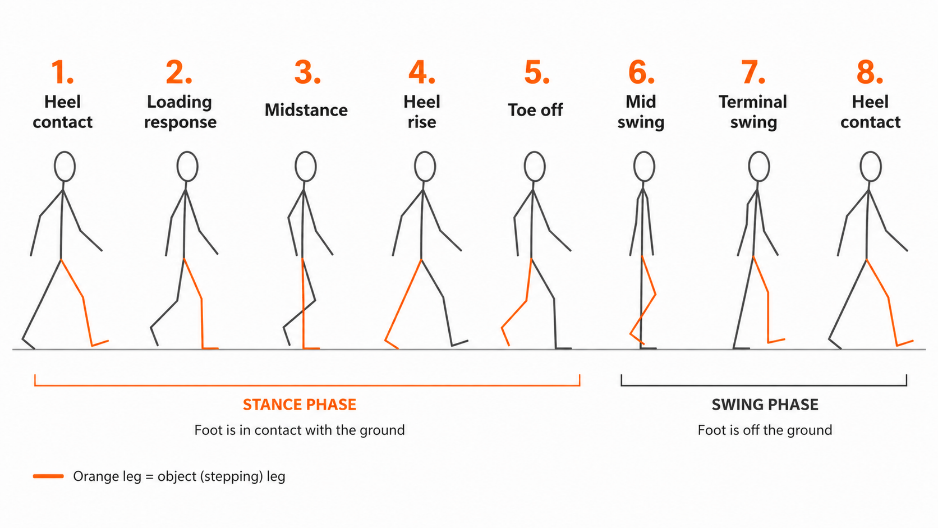
First Contact — Accepting Load
Heel strike (≈0–80 ms)
Body and limb position
- The opposite limb is completing its stance phase
- The new stance limb contacts the ground at the heel
- The ankle is dorsiflexed and the knee slightly flexed
- The body’s centre of mass remains behind the foot
At heel strike the foot begins accepting load from the ground.
Only the heel is in contact with the surface and the forefoot has not yet loaded. The joints of the foot therefore remain relatively compliant, allowing the foot to begin adapting to the ground as body weight transfers through the limb.
Just before contact the toes naturally extend slightly as the limb swings forward. This places a small amount of tension in the plantar fascia before the foot reaches the ground (1).
When the heel contacts the ground, the heel fat pad begins absorbing impact while the pre-tensioned fascia helps stabilise the arch. As the forefoot lowers during the next phase of stance, tension within the fascia rises further.
Even at this early stage of the step, the connective tissues of the foot are beginning to load.
Settling Onto the Ground
Loading response (≈80–200 ms)
Body and limb position
- Body weight begins transferring onto the stance limb
- The opposite limb lifts into swing
- The knee flexes slightly to absorb load
As the step continues the forefoot lowers toward the ground until the entire plantar surface makes contact.
Ground reaction forces rise rapidly during this phase as body weight is transferred onto the stance limb. The arch begins accepting compressive forces from above while the ground pushes upward beneath the foot.
This is the point where the foot starts to organise the load it has accepted. The heel pad, arch, plantar fascia and surrounding soft tissues all contribute to how that load is managed.
The bones of the arch resist compression while the soft tissues beneath and around the arch begin taking up more tension.
These early changes set the conditions that allow the foot to stiffen later in stance.
The Arch Begins to Load
Foot flat / early mid-stance (≈200–350 ms)
Body and limb position
- The entire plantar surface contacts the ground
- The tibia begins advancing over the ankle
- The opposite limb continues forward through swing
With the whole foot on the ground, body weight continues progressing over the stance limb.
As load passes through the foot the medial longitudinal arch deflects slightly under body weight. This movement increases the distance between the calcaneus and the metatarsal heads.
As that distance increases, the plantar fascia stretches and tension rises within its fibres. Biomechanical studies have shown that the plantar fascia experiences substantial tensile loading during walking (2,3).
At the same time the ankle dorsiflexes as the tibia advances forward. The calf muscles control this movement eccentrically, allowing the Achilles tendon to lengthen under load.
Both structures contribute to progressive stiffness. As they are tensioned, mechanical energy begins to accumulate within the foot–ankle system (4,5).
More recent work using ultrasound and elastography has shown that plantar fascia stiffness increases as the tissue is stretched during weight-bearing (6).
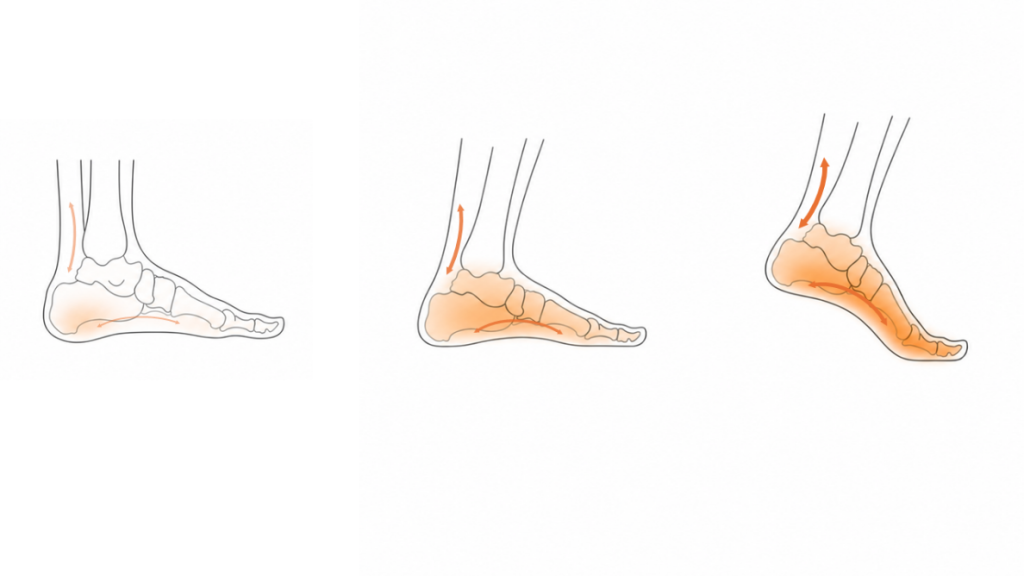
Loading the Spring System
Mid-stance (≈350–450 ms)
Body and limb position
- Body weight is now directly over the foot
- The stance limb supports the body
- The opposite limb continues forward through swing
By mid-stance the forces acting through the foot have increased substantially.
Ground reaction forces during walking typically approach approximately 1.2 times bodyweight (7). The tibia continues advancing over the ankle, increasing stretch within the Achilles tendon.
Beneath the foot, the arch continues to deflect slightly under load, increasing tension within the plantar fascia. The intrinsic foot muscles also become more important here, helping control arch motion and support the stiffening process.
The foot is still adapting to the ground, but it is also becoming progressively stiffer. As tension rises within these tissues, the foot becomes more resistant to deformation.
The spring system is now fully loading.
Rising Tension
Late stance / heel rise (≈450–600 ms)
Body and limb position
- The centre of mass moves ahead of the foot
- The heel begins to lift from the ground
- The opposite limb prepares for contact
As the body moves forward beyond the foot, load shifts toward the forefoot.
The Achilles tendon reaches a greater stretch while the plantar fascia continues resisting elongation beneath the arch. The intrinsic foot muscles and the calf complex contribute to this phase as the foot prepares for propulsion.
The foot now behaves less like a flexible structure and more like a tension-stiffened system.
Biomechanical work has shown that the foot contributes actively to propulsion, with the midfoot performing positive mechanical work during push-off (8).
As tension rises, elastic energy is stored within the plantar fascia and Achilles tendon. When the heel rises, some of that energy is returned and contributes to forward progression.
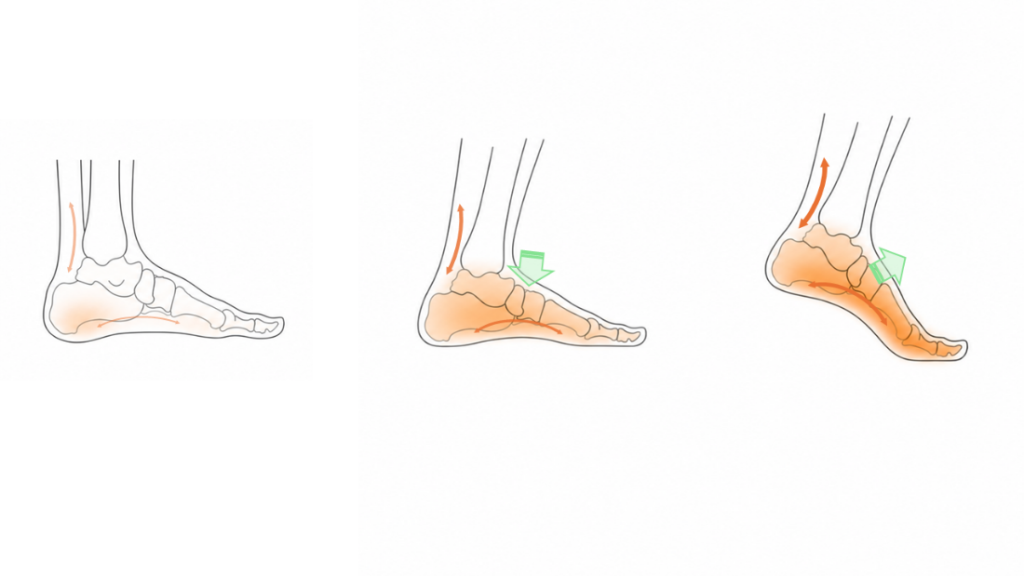
Releasing the Spring
Propulsion and toe-off (≈600–700 ms)
As the centre of pressure moves toward the toes, the hallux dorsiflexes.
This activates the windlass mechanism, where the plantar fascia wraps around the metatarsal head (1).
Importantly, the plantar fascia has already been tensioned earlier in the step. The windlass mechanism increases tension that has already developed rather than creating it from nothing.
It is one part of the overall stiffening process. It amplifies existing tension and helps convert the foot into a more rigid lever during late stance.
Elastic energy stored earlier in the step is now released as the system recoils, contributing to forward progression (4–6).
Completing the Cycle
As the foot leaves the ground the toes often remain slightly extended as the limb swings forward.
This means the plantar fascia is not fully unloaded before the next step begins, allowing a small amount of tension to persist into the next step.
As the foot contacts the ground again, that tension rises once more.
In this way the mechanical cycle of the foot repeats continuously during walking and running.
Mechanical Driver
The main mechanical driver of foot stiffening is progressive load transfer over the foot during stance.
As body weight moves forward:
- the arch deflects
- the plantar fascia is tensioned
- the Achilles tendon stores elastic energy
- the intrinsic foot muscles help stabilise the arch
- the hallux and first ray prepare for propulsion
In normal gait, this creates a coordinated sequence of compliance followed by stiffness.
When that sequence is altered, the foot may not fully develop the tension needed for efficient propulsion.
When the System Does Not Fully Load
If tibial progression is reduced or heel rise occurs too early, the foot does not develop as much tension through the arch and Achilles tendon during mid-stance.
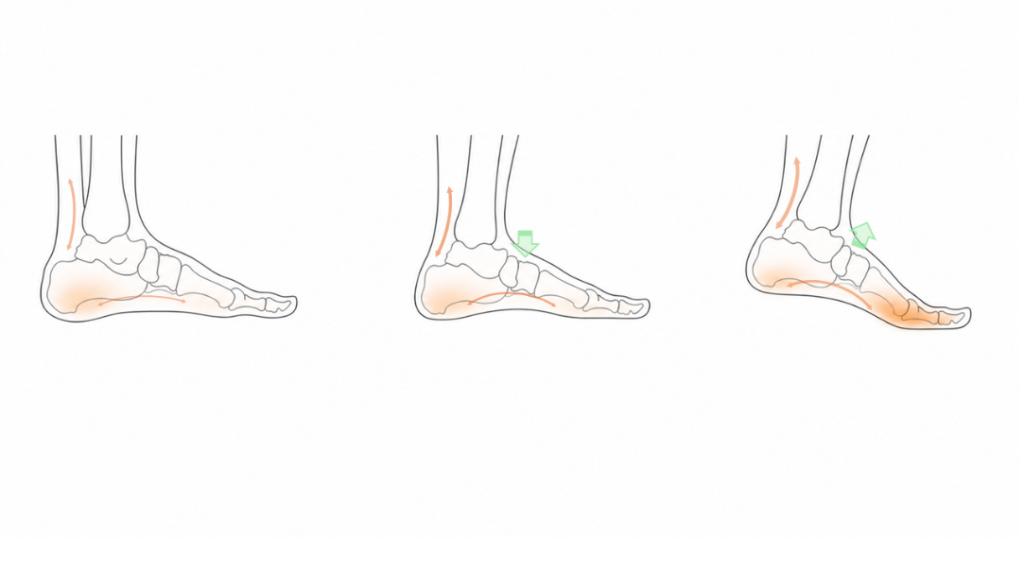
When this happens:
- the arch does not fully engage
- the plantar fascia is not fully tensioned
- the foot stiffens less efficiently
- the forefoot is asked to accept load earlier than ideal
The foot still functions, but less efficiently.
Instead of a coordinated spring system, load is redistributed earlier to tissues that may not be best placed to handle it.
This matters clinically because altered timing can help explain why symptoms develop beneath the heel, midfoot, forefoot, or along the first ray when gait mechanics change.
Rehab Implications
If the foot is not stiffening well during stance, the question is not usually whether to stop loading it altogether. The more useful question is why the system is not tolerating load well.
Useful rehab priorities include:
- improving calf capacity for controlled tibial progression
- strengthening the intrinsic foot muscles
- restoring tolerance to repeated arch loading
- addressing ankle mobility where it limits progression
- temporarily modifying load if symptoms are sensitive
- using orthoses where appropriate to redistribute load rather than replace function
Orthoses can be useful when they help reduce stress on an irritable tissue while active capacity is being rebuilt. Their role is to modulate load, not to do the work of the system.
The aim is to restore the foot’s ability to move through its normal sequence of compliance, stiffness, and propulsion.
Clinical Takeaway
The foot does not become stiff because of joint position alone.
Stiffness emerges from progressive tension within the plantar fascia, Achilles tendon, and supporting muscles as the body moves over the foot.
That tension allows the foot to:
- transition from a compliant structure to a stiff, load-bearing system
- store mechanical energy during mid-stance
- release that energy during propulsion
Timing matters.
If the foot does not fully load during mid-stance:
- tension does not fully develop
- energy storage is reduced
- the system becomes less efficient
- load shifts earlier to the forefoot
This gives us a useful mechanical framework for assessing and managing foot and ankle problems.
Understanding how the foot stiffens during walking and running helps explain why symptoms develop when load timing, load magnitude, or tissue tolerance becomes mismatched.
Summary
The foot does not suddenly become rigid during push-off. Instead, it stiffens progressively as body weight moves over it and connective tissues are tensioned.
During stance, the arch deflects slightly under load, the plantar fascia and Achilles tendon store elastic energy, and the intrinsic foot muscles contribute active support. As heel rise begins, the windlass mechanism adds further tension and helps the foot act as a stable lever for propulsion.
If this sequence is disrupted, the foot may not develop stiffness efficiently and load may shift earlier to structures that are less well prepared to handle it.
From a clinical perspective, this sequence helps explain why symptoms develop when loading patterns change and why rehabilitation should focus on restoring both capacity and timing.
Looking Ahead: Directing Propulsion
Stiffness alone is not enough for efficient propulsion.
As the foot stiffens during late stance, load also has to be directed effectively through the forefoot. In most cases this occurs through the medial forefoot and hallux.
If the foot does not fully develop tension during mid-stance, propulsion may shift toward the central forefoot instead, exposing different tissues to increased mechanical demand.
Understanding how the first ray and hallux contribute to this process provides the next step in understanding foot mechanics.
References
(1) Hicks JH. The mechanics of the foot. II. The plantar aponeurosis and the arch. J Anat. 1954.
(2) Erdemir A et al. Dynamic loading of the plantar aponeurosis. J Biomech. 2004.
(3) Wearing SC et al. The pathomechanics of plantar fasciitis. Sports Med. 2006.
(4) Ker RF et al. The spring in the arch of the human foot. Nature. 1987.
(5) Alexander RM. Energy-saving mechanisms in walking and running. 1991.
(6) Welte L et al. Foot arch energy storage. 2021.
(7) Winter DA. The Biomechanics and Motor Control of Human Gait. 1991.
(8) Zelik KE, Honert EC. Ankle and foot power in gait. J Biomech. 2018.